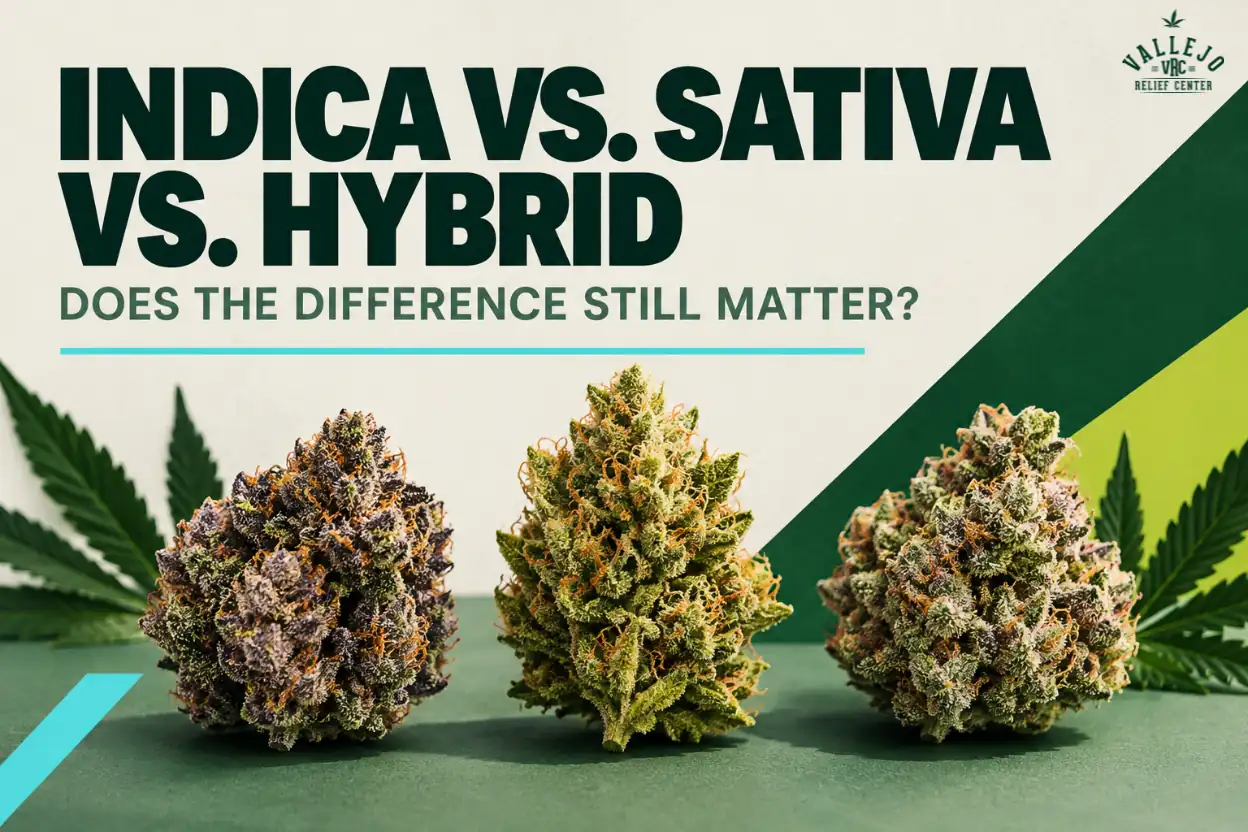
Here’s the deal on indica vs. sativa vs. hybrid.
If you’ve shopped at a dispensary more than twice, you know the drill. Budtender asks what you’re looking for. You say indica or sativa. They nod, point you somewhere on the menu, and off you go.
It works well enough as a starting point. The thing is, it’s only a starting point — and a lot of people never find out there’s more to it. If you’ve ever grabbed a “sativa” that had you knocked out by 9pm, or an “indica” that had your brain running laps, that’s exactly why.
The categories aren’t wrong. They’re just incomplete. Once you understand what’s actually going on inside the plant, choosing flower gets a lot more interesting and a lot more consistent.
Where the whole indica vs. sativa thing came from
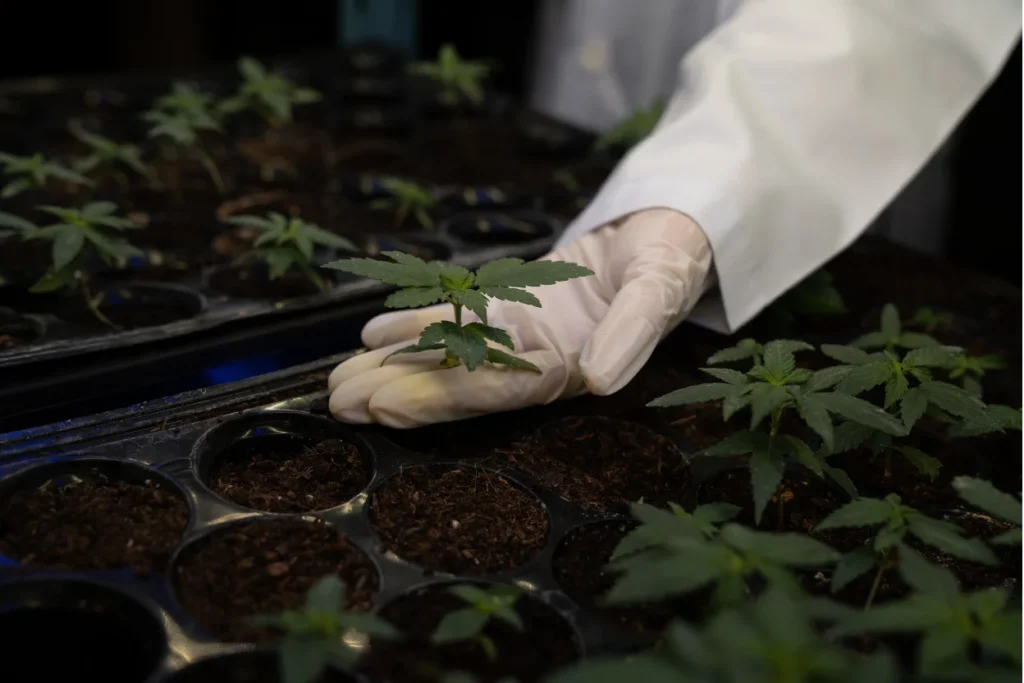
The original distinction was about plant biology, not about how your session would go.
Indica plants came from the Hindu Kush mountain range — short, dense, bushy, built for cold climates and high altitude. Sativa plants came from equatorial regions like Southeast Asia and Central America — tall, airy, longer growing season. Farmers noticed that plants from these different parts of the world seemed to hit differently, and the shorthand eventually made it onto dispensary menus worldwide.
The traditional take:
- Indica — body-focused, relaxing, good for winding down, the couch-lock classic
- Sativa — cerebral, uplifting, better for daytime use, social situations, or getting creative
- Hybrid — a mix, leaning one way or the other depending on its genetic makeup
That’s still useful context. The problem is decades of crossbreeding have made this map pretty blurry.
Why the labels don’t always match the experience
Here’s where it gets interesting. True pure indicas and true pure sativas are genuinely rare in a licensed dispensary today. Even strains labeled “indica” or “sativa” almost always have crossover in their lineage. In fact, over 60% of commercial strains combine indica and sativa genetics in varying ratios. Pure landrace strains like Hindu Kush or Durban Poison exist, but they’re the exception, not the rule.
What that means in practice: two strains carrying the same “indica” label can produce completely different experiences. One might flatten you. Another might leave you relaxed but totally functional. Same story on the sativa side. Researchers have actually gotten to the point of recommending that cannabis be classified by its chemical profile rather than plant shape, more like a nutrition label than a botanical category.
So if the label isn’t the full story, what is?
Terpenes — the thing that actually matters
The compounds that shape your experience have nothing to do with whether a plant grew short or tall. They come from terpenes — the aromatic molecules that give each strain its smell and play a huge role in how it hits — and from the full cannabinoid profile beyond just the THC percentage.
That difference in smell between jars? The one that makes certain strains smell earthy and dank, others bright and citrusy, others like straight pine? That’s terpenes. And research points to them as meaningful drivers of how a strain actually feels, not just how it tastes.
Some of the big ones to know:
- Myrcene — Earthy, musky, dank. Tends toward body relaxation and sedation. Shows up heavily in a lot of strains marketed as indica, which is a big reason why the “indica = heavy” pattern holds up sometimes.
- Limonene — Bright and citrusy. Generally associated with mood elevation and a lighter, more uplifted feeling. Common in strains that actually deliver on the sativa energy promise.
- Pinene — Fresh pine. Linked to alertness and mental clarity. Interestingly, it may also help dial back some of the short-term memory fog that comes with high-THC flower.
- Linalool — Same compound that makes lavender calming. Shows up in certain strains and tends to soften and mellow the whole experience.
- Caryophyllene — Spicy and peppery. The only terpene known to directly interact with the body’s CB2 receptors, and it’s associated with a relaxing, anti-inflammatory quality.
And terpenes don’t work alone. This is where the entourage effect comes in. The idea — supported by research from neurologist Dr. Ethan Russo published in the British Journal of Pharmacology — is that cannabinoids and terpenes work better together than they do in isolation. A flower with a rich terpene profile hits differently than a stripped-down high-THC product at the same percentage, because the full chemistry of the plant does something that isolated compounds don’t.
This is also why chasing THC percentage alone is kind of a trap. A well-grown 22% with a complex terp profile will often be a better session than a 30% with nothing going on behind it. The number on the label is one data point, not the whole picture.
So does indica vs. sativa still matter?
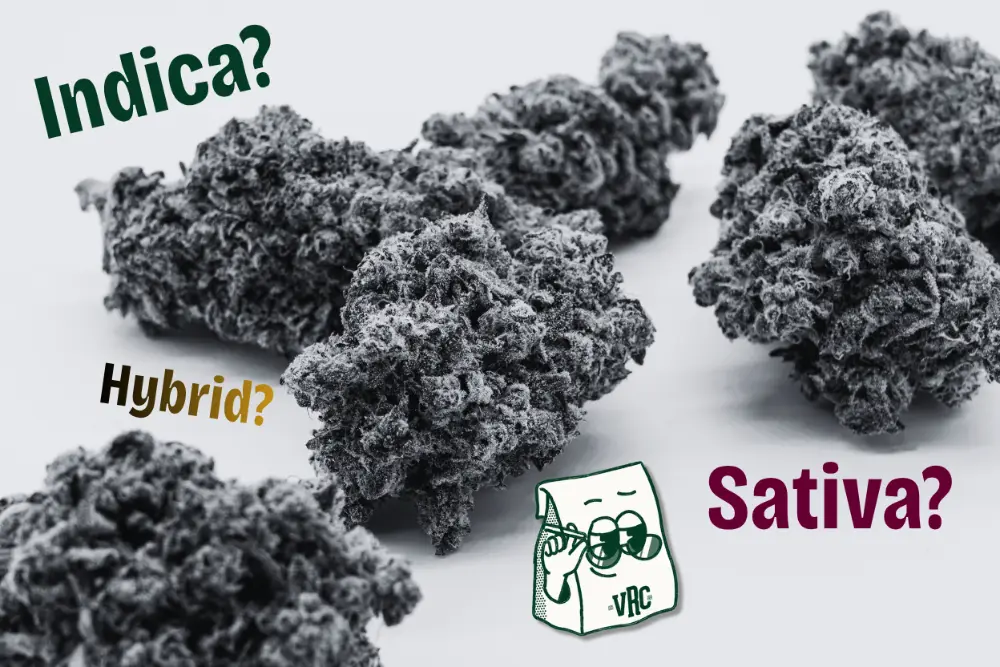
Short answer: yes, as a first filter. No, as the final word.
It’s still useful shorthand. If you want to unwind at the end of the day, telling your budtender you’re leaning indica is a fine place to start the conversation. It narrows the menu and points things in the right direction.
It just can’t be where you stop. The label tells you about rough tendencies, not what’s actually in the jar. Two strains with the same label grown by different cultivators can produce significantly different effects depending on their terpene profile and how they were grown. The category is a starting point, not a guarantee.
The smarter move is to use the category as a first screen, then go deeper. Look at the terp profile if it’s listed. Tell your budtender what you actually want out of the session — not just the category, but the experience.
Still figuring it out? See what’s on the shelf and find your match.
How to shop smarter at VRC
Our budtenders know what’s on the menu; not just the label, but the profile, the brand, and what people are actually saying about how it smokes. The more specific you can be about what you’re going for, the better we can match you.
You don’t need to walk in with the vocabulary. Just bring the intention:
- “I want to relax but not get flattened” — we’ll look for something myrcene-forward but balanced, usually an indica-leaning hybrid that doesn’t go full couch-lock
- “Something social and easy, not anxious” — limonene-forward, moderate THC, nothing too high-test; hybrids in the 18–22% range with good terp content usually hit the mark
- “I want to actually get stuff done” — pinene or terpinolene-forward, clear-headed; some sativa-leaning hybrids are built exactly for this
- “Help me sleep” — high myrcene, higher THC, maybe some linalool in the mix; this is where indica-dominant strains genuinely earn their reputation
- “I’m newer and don’t want it to be too much” — totally valid, and useful info; we’ll steer you toward something with a balanced THC-to-CBD ratio and a gentler profile
No jargon required. Tell us how you want to feel and we’ll go from there.
Indica, sativa, hybrid — the categories aren’t going anywhere, and they’re not useless. Just treat them as the menu’s first filter, not the final answer. The real story is in the terpenes, the cannabinoid profile, and how all of it lands for you specifically.
Once you start thinking that way, your sessions get a lot more consistent. Less lottery, more of what you actually came for.
Stop by the shop in Vallejo or browse the current menu at Vallejo Relief Center’s online shop.